
Updated: Apr 1
If you have ever wondered if the lighting in your home could be the reason you can't fall asleep at night then this article is for you. Determining which lighting goes in which room is highly important to follow your bodies natural cycle. Read more to find out why LED lighting may be the option you are looking for.
1. Lighting and Circadian rhythm
When deciding on the type of lighting to go into a specific room, it’s important to select lighting that positively affects our waking and sleeping patterns. Both natural and artificial lighting have an impact on our overall health and daily routines. The human body runs on a 24-hour cycle, known as our circadian rhythm, that is dependent on the light and dark throughout the day. This occurs due to photoreceptors in our eyes that respond to various wavelengths of light.
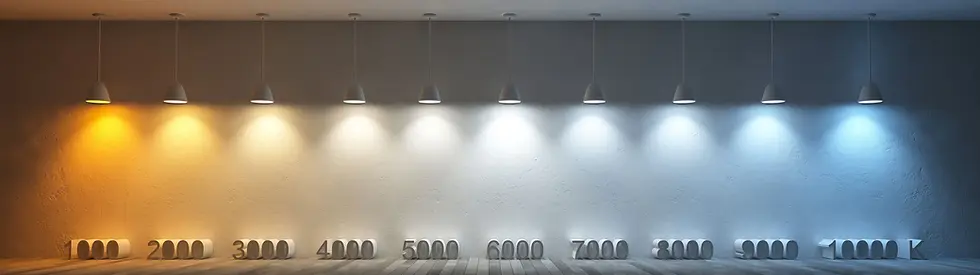
Since our bodies respond to the wavelengths of light, it is important to note that the temperature of this light also plays a large role. Since temperature plays a role in regulating our 24-hour system, it is important to adjust indoor temperature lighting accordingly. The average person spends about 90% of their time indoors, meaning indoor lighting is impactful to the majority of people. Lighting that is displayed indoors should mimic the lighting that occurs naturally outdoors to regulate our bodies properly according to this circadian rhythm.
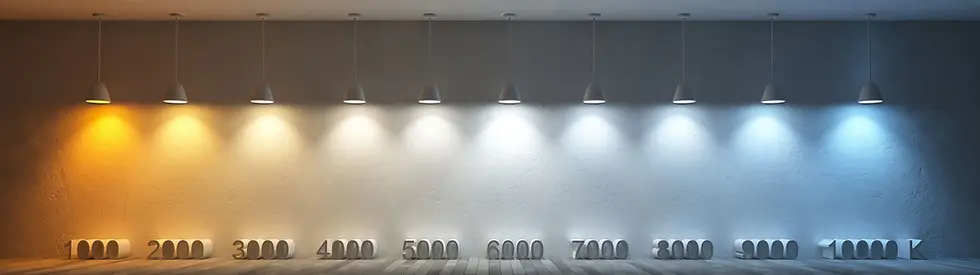
Though this lighting ties into the bodies’ natural processes, when designing any space, it is important to understand how lighting impacts your mood and activity levels. Lighting temperature should specifically align with the end goal for space, and the bodies daily functions. For example, the use of cool blue wavelengths are traditionally placed in commercial places to improve visibility and in workplaces to keep you feeling alert through a long workday. Typically, this color lighting is best used around midday. Whereas warmer wavelengths are a great alternative for comfort and winding down later in the day. These warm lights can be strategically placed in bedrooms or areas of the home where you can relax. In the evening, warm lighting should be used to promote relaxation and help the body prepare for its ongoing cycle. Though this may seem easy, the blue light that is found in many electronics, suppresses the bodies natural production of melatonin which allows us to fall asleep. Melatonin plays a crucial role in our sleep patterns and impacts on our daily habits, disrupting this could pose health risks if too much blue light is present.
The discussion about having the ability for color-changing or dimmable lighting becomes relevant when considering these details. Color changing and dimmable LED lighting is a viable option for rooms that serve numerous purposes throughout the day. It's important to invest in the lighting that is placed in rooms that you frequently visit throughout different times of the day. Bathrooms are often a prime example of a room that serves multiple purposes. Adjusting the lightings visibility or color to match specific times of day is a great option to improve your quality of life.

A few things worth noting:
Our circadian rhythm is dependent on light which sends signals to the brain
The color and wavelength of lighting is important
Benefits of choosing LED lighting compared to incandescent lighting
2. Dimmable lighting
Typically, a bathroom mirror includes tasks such as getting ready in the morning or performing self-care routines. The lighting in your bathroom should provide options to match the natural temperature throughout the day, and work with your routine, not against it. Oftentimes, you may need to adjust the lighting in the room depending on the task being performed. This is why color changing/dimmable LED Lighting options would be a great alternative for those looking to match their day-to-day tasks. Changing the specific color using LED lighting is a quick way that you can stay on track with your routine. Dimmable lighting is an excellent choice for lights that may be too bright or too dark for parts of your everyday routine. When utilized together, these options provide the user with the customization suited best for personal needs.
3. Importance of Kelvin and LED
Kelvin (K) is the SI unit of temperature. Kelvin is known for the warmth or coolness of the bulb. Decreasing in Kelvins allows the body to naturally produce melatonin to prepare for sleep and avoid health related risks. Kelvin temperature increases to its highest point at 5000K-6000K, throughout your day it decreases to 2000K-3000K to prepare your body for rest. Following this unit of temperature allows you to determine which Kelvin works best for specific design needs, or of your routine every day.
The term LED stands for light-emitting diode. This form of lighting lasts longer, is more sustainable and uses at least 75% less energy than traditional bulbs. Compared to incandescent bulbs, LED fixtures can produce 150 lumens/watts while incandescent bulbs produce 20 lumens/watts. Aside from light emitted, there are other benefits such as cost savings when choosing LED Lighting. LED Lighting can save the overall cost of electricity, low heat output, less expensive replacement costs and increased life span in hours. Thus, meaning there is far less maintenance and improved performance when using LED Lighting. LED Lighting is a suitable option for those looking to purchase lighting that is long-lasting and uses less energy, which may be more sustainable for both the customer and the environment. Overall, LED lighting is a great choice for both efficiency and effectiveness.
4. Understanding the Color Rendering Index
When it comes down to LED Lighting, it is important to recognize what is known as a the Color Rendering Index (CRI). The CRI measures how accurate artificial lighting shows an object’s colors compared to natural lighting. For example, sunlight has a perfect CRI of 100. CRIs that are lower than 80 dull out objects and do not accurately demonstrate shape or color of the object. Bathroom mirrors with a CRI of 90+ reflect the most accurate color depiction best suited for applying makeup, shaving or completing tedious or everyday tasks.
CRI is determined by averaging the color rendering for eight standard color samples that are light in saturation (R1 through R8), drawn from European technical standard DIN 6169, Color Rendering. Some manufacturers chose to test six additional colors that are saturated colors (R9 through R14 and sometimes R15). These saturated colors don’t contribute to CRI. However, some manufacturers like to report R9, which is saturated red, as this demonstrates that their light product effectively portrays wood and skin tones. An R9 value of 50+ in conjunction with a CRI of 90+ is needed to depict colors and match makeup to skin tone accurately”. (Page 31).- Ketcham AEC Daily Course. (https://www.aecdaily.com/course.php?node_id=2175762)
5. Lighting placement
Since lighting is extremely important, it is beneficial to know which type of lighting best suits your needs. There are several options available, including back-lit, front-lit, and frosted edges, each serving a distinct purpose. Back-lit mirrors have LEDs attached at the back of the mirror, the lighting reflects off the wall, these are best fitted for a softer glow. Back-lit mirrors would be a great option for those who want to achieve a bright light that eliminates shadows. Frosted edges allow a specific amount of light to shine through; these can be customized to fit aesthetic purposes and a more subtle glow compared to other options. Manufacturers may offer frosted edge mirrors with custom patterns etched into it. Front-lit mirrors have these LED strips in the face of the mirror. This form of front-lit usually results in a brighter light that can light the entire room with no obstructions. Front-lit mirrors help to eliminate shadows that may occur and are great for completing tasks. All of these options are available to provide homeowners and project designers with the ability to take the rooms’ lighting to the next level.
6. Bonus elements to add to your mirrors
Continuing with easy ways to customize lighting, there are no boundaries when it comes to additional elements. Options such as the mirrors shape, touch sensors, defoggers and dimmable lighting are assets that can provide you with exactly what you are looking for. The shape of these mirrors or medicine cabinets can change the overall aesthetic that the room provides. Different shapes may fit unique sized bathrooms, elevate the room, or just assist tasks as an everyday mirror. Touch sensors allow for easy accessibility and customization. Another option is a defogger, these are an excellent addition for users that may need to access LED lighting when a bathroom is foggy. Finally, dimmable lighting is a great alternative for those who may struggle with chronic headaches, want to change the mood, or need the ability to change lighting from low to high. Customizations can also include integrated speakers, charging outlets, clocks and various alternatives to improve the users experience. The selection is endless to find the perfect match for your needs.

7. ADA Compliance
As for functional purposes, in many different settings, ADA compliance is crucial. This means locating mirrors to accommodate many people of differing abilities. For mirrors to be usable by those who are ambulatory and people who use wheelchairs, the top edge of mirrors should be 74 inches minimum from the floor or ground. Operable parts should be able to operate using one hand and should not require grasping, pinching or twisting of the wrist. The force required for these products should be 5 pounds. A great option including this would be medicine cabinets with touch sensors and slotted finger pulls on the underside of the cabinet.
8. Ketcham AEC Daily course
Our AEC Daily course provides architects, designers and many others with a better understanding regarding the ins and outs of LED lighting. By focusing on light quality, energy efficiency, and compliance, our course reinforces why integrated LED solutions are mainly the industry standard. Feel free to take our course to learn more about LED lighting!
For more information regarding Ketcham Medicine Cabinets LED Lighting contact us by email sales@ketchamcabinets.com, or by phone (631) 615-6151.
